
Medical lien management software
Medical lien management software built for personal injury workflows
Personal injury medical liens are not ordinary receivables.
Treatment, the legal case, reductions, and payment move on different timelines, usually across different organizations. PatientLIENQ connects that work in one operating environment, and ProviderLIENQ+ is the application for medical entities managing their own lien portfolios.
Who needs it
Who needs medical lien management software.
Any medical entity treating personal injury patients on a lien carries a portfolio of accounts that resolve when cases resolve. The way that portfolio is held decides what the software has to do.
Medical entities managing their own liens
Clinics, groups, and multi-location practices that hold their own personal injury liens and maintain direct relationships with law firms. They need workflow ownership, open A/R, reductions, ledgers, and portfolio visibility in one place. This is who ProviderLIENQ+ was built for.
Medical entities working with funding partners
Providers participating alongside institutional funding partners receive referrals, manage treatment workflows, and coordinate with funding partners and law firms through ProviderLIENQ inside the PatientLIENQ ecosystem.
Facility based lien management
Surgical centers and other facilities managing Facility based liens, multi-entity structures, and large A/R migrations are supported through ProviderLIENQ+ Enterprise. See how Enterprise routing works.
Why it gets hard
Why spreadsheets and generic systems become difficult at scale.
A spreadsheet can hold a balance. It cannot hold the next step. It does not know that a visit was missed, that a recommendation is waiting on an Authorization, that a law firm sent a reduction request last week, or that a records request is still open.
Systems built around insurance billing assume a payer, an adjudication cycle, and a remittance. A personal injury lien has a patient who is still treating, a case that may take years, a reduction negotiation at the end, and a payment that depends on settlement.
So the real work moves into email chains, calendar reminders, handcrafted forms, and manual follow-up. Across multiple locations, consistent aging methodology and portfolio visibility become increasingly important.
The people are not the problem. The infrastructure can be improved. That is the PatientLIENQ Method.
What it should manage
What medical lien management software should actually manage.
Each of these changes the state of the others, so they belong in one operating environment.
Treatment activity
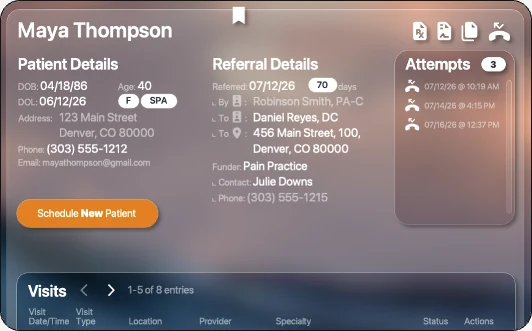
Patient and intake details, scheduled visits, logged Attempts, visits attended, and charges, so follow-up starts from what actually happened.
Workflow ownership
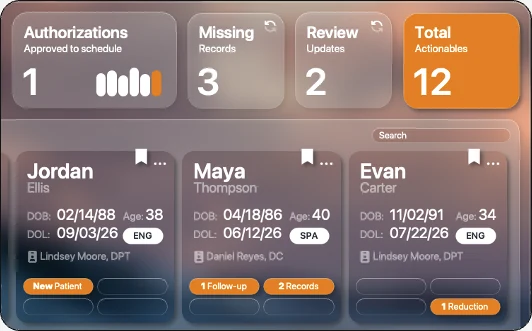
Actionables organize scheduling, Authorizations, missing records, review items, bills, reductions, new patients, and follow-up into clear action queues with an owner.
Recommendations and Authorizations
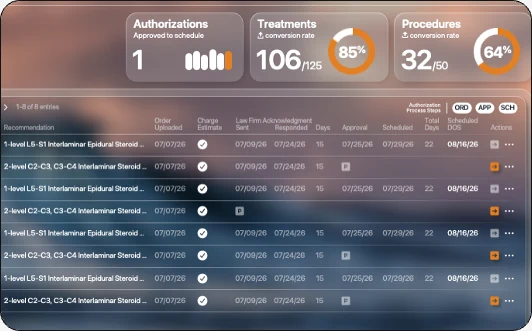
Procedure recommendations, the authorization table, and treatment and procedure conversion rates across the portfolio.
Reductions
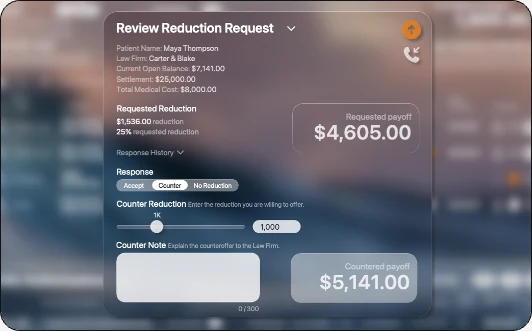
Requested payoff, accept, counter, or no reduction, the countered payoff, and the note that explains it, handled as a workflow instead of an inbox thread.
Open A/R and payments
Active lien accounts, outstanding balances, workflow status, reduction activity, aging, and portfolio-level follow-up.
Reporting and documents
Portfolio metrics such as collections, A/R aging, visit charge, and time to close, plus ledgers, forms, lien related records, and customer-facing documentation.
Actionables + PatientCards
Scheduling + Attempts
Portfolio Authorizations
Reductions + Patient Financials
Portfolio visibility
Know what is happening across the portfolio.
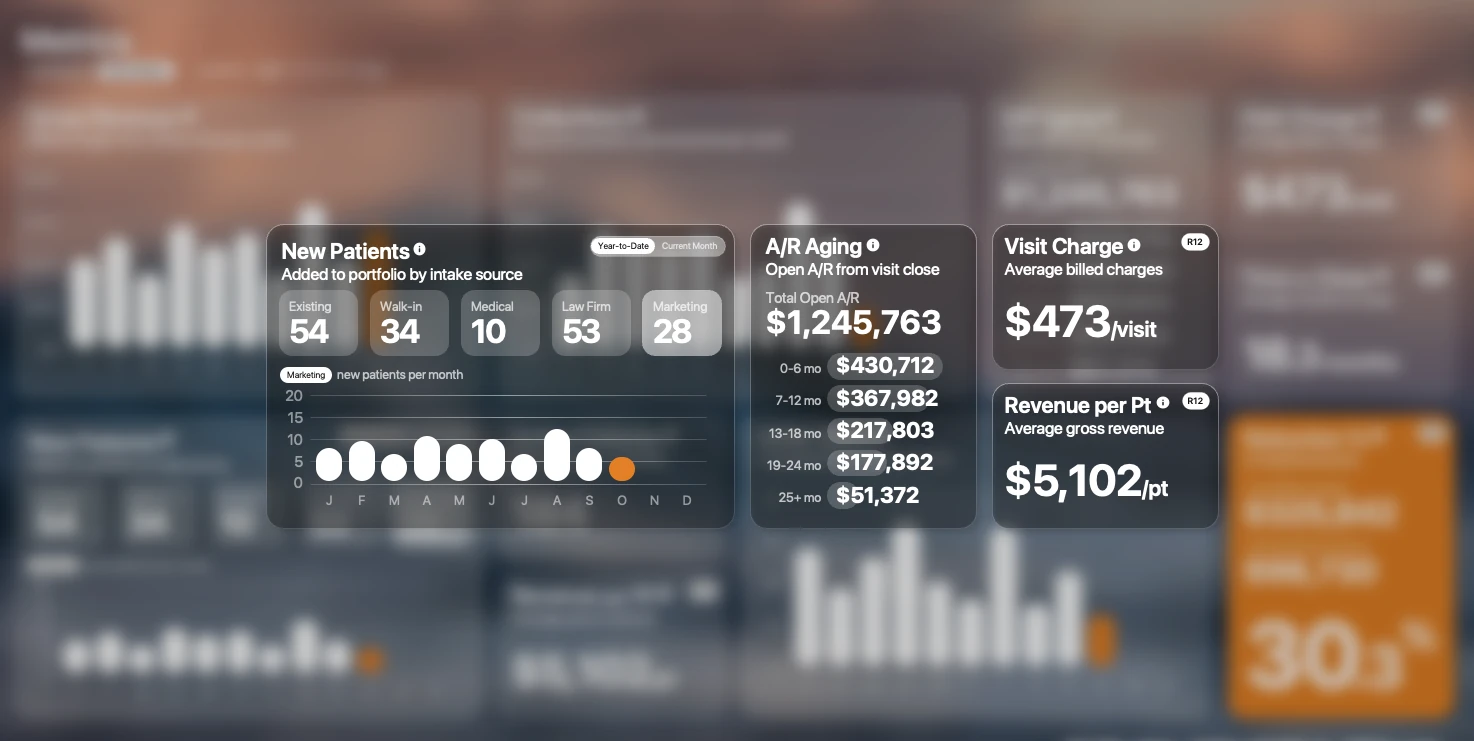
Open A/R is not just a report. It is the operating view of the lien portfolio.
ProviderLIENQ+ Portfolio Metrics bring intake sources, open A/R aging, visit charge performance, collections, time to close, and revenue per patient into one view, without disconnected reports or spreadsheets.
The other side of the lien
Connected to the law firms and funding partners who share the work.
A medical lien is resolved with a law firm, and often alongside a funding partner. PatientLIENQ connects Providers, Attorneys, and Funders around shared information while each organization keeps its own responsibilities and data boundaries.
Through AttorneyLIENQ, law firms stay informed on treatment progression, communicate client decisions, respond to Actionables, and send reduction requests inside the same environment the provider works in.
Participation does not expose another organization's patient volume, portfolio activity, account information, or business data. How controlled visibility works.

The application for medical entities managing their own liens.
ProviderLIENQ+ brings key lien resolution workflows into one connected platform environment inside the PatientLIENQ ecosystem.
- First active clinic location$200/month
- Each additional active clinic location+$150/month
- Imaging Liens module+$150/month
- Annual prepaid optionSave 10%
- Activation Fee$100 one time
Self-service enrollment for up to 5 active lien-holding clinic locations. 6 or more, Facility based lien management, complex multi-entity structures, and large A/R migrations route to Enterprise pricing.
Common questions
Common questions about medical lien management software.
Is PatientLIENQ for personal injury medical liens only?
Yes. PatientLIENQ is built for liens held by medical entities for treatment delivered to personal injury patients, and for the law firms and funding institutions involved in resolving them. It is not a tool for other kinds of liens.
How does an existing lien portfolio get into ProviderLIENQ+?
The Activation Fee includes account activation, first admin setup, settings review, and one standard CSV upload. Large A/R migrations are handled through ProviderLIENQ+ Enterprise.
Does the law firm have to use PatientLIENQ too?
Law firms participate through AttorneyLIENQ, where they see treatment progression for their clients, communicate client decisions, respond to Actionables, and send reduction requests. Each organization sees only the information it is permitted to access.
What does activation include?
The $100 Activation Fee includes account activation, first admin setup, settings review, and one standard CSV upload. Additional implementation needs may require Enterprise review.
Who can see our portfolio?
Your organization, through role based access. PatientLIENQ maintains tenant-level data separation and configured relationship boundaries, so participation in the ecosystem does not expose your patient volume, portfolio activity, or business data to anyone else.
Ready to manage your lien portfolio with more visibility?
A more structured way to manage lien resolution, open A/R, reductions, ledgers, and portfolio workflows.